About me and this site
Just a Filipino percussionists with a background in Classical music sharing my personal experiences and journey with Kulintang.
With the permission to share, of course.
Who am I?
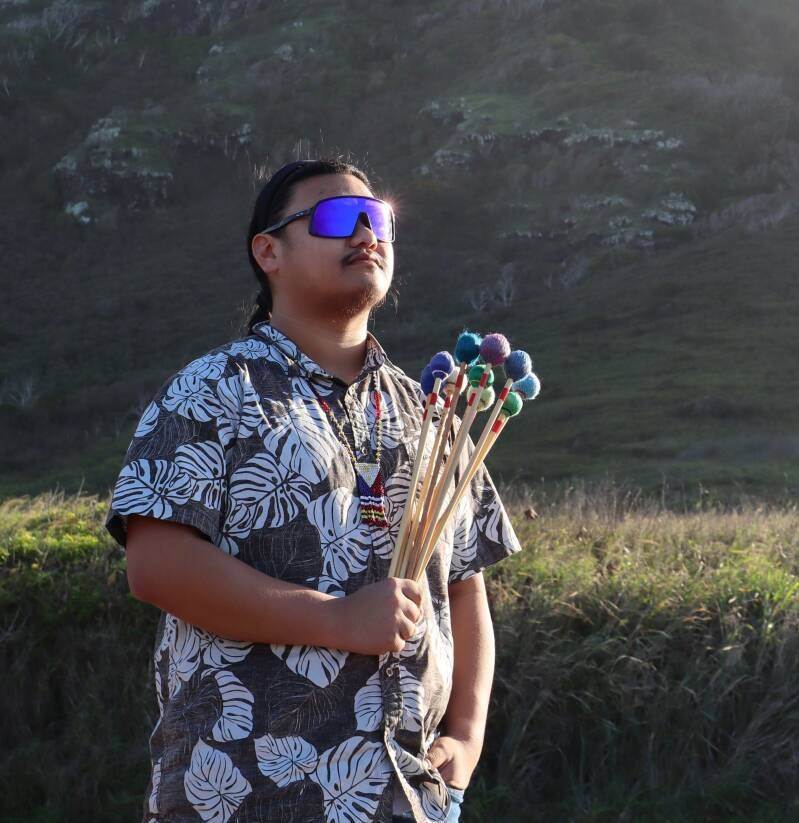
My name is Kevin Calamayan, and I am a percussionist, educator, composer, and arranger based on O'ahu, Hawai'i. My work centers on percussion education, where I teach private lessons, coach percussion sections at middle and high schools, and write original music as well as arragements for marching band percussion sections and percussion ensembles. Alongside teaching and composing, I continue to try to perform regularly, including as the principal percussionist of the Nāulu Winds of the University of Hawaiʻi–West Oʻahu, and very occasional appearances with the Royal Hawaiian Band.
I graduated from the University of Hawaiʻi at Mānoa with a degree in music, where I served as the principal percussionist and one of their drumline section leaders. My musical training has been deeply rooted in Western classical percussion, and my work today spans education, composition, arrangement, and performance.
I personally believe that studying music extends way beyond just learning notes and rhythms as it includes understanding the people, histories, and traditions from which it comes.
What is this site?
This site exists for a few reasons.
Over the years, I’ve met countless people who are curious about kulintang. Many of them had never heard of it until someone introduced it to them, which was also the case for me. When I started learning, I realized how hard it can be to find beginner-friendly information. Nothing replaces learning directly from those who carry the tradition, and there will never be a substitute for that. However, I wanted to create a small starting point for anyone who wants to understand what they are looking at before choosing whether or not to dive deeper into the tradition.
This space is also something personal for me. I wanted a place to keep track of the pieces I’m learning and the cultural context that comes with them. The repertoire is quite vast. Balancing my classical percussion background with learning Kulintang can become overwhelming. Having this public record helps me hold onto what I’ve learned, and if it happens to help someone else who is starting out, that’s even better.
More than anything, this site reflects where I am in my own learning. I’m not speaking for the whole tradition, I’m simply sharing what I learned so far. My hope is to make Kulintang feel a little more approachable, while still pointing people toward culture bearers and communities who carry this music every day. It's also important to note that not every piece I learned will be public here. I've learned pieces from different teachers and it is their choice to allow me to share their teachings to the public.
This site was created as the capstone requirement for my undergraduate degree program and was supervised by ethnomusicologist Dr. Ricardo D. Trimillos.
What's my musical background?
I joined band in seventh grade as a percussionist after my parents signed me up, initially seeing it as something fun rather than something I would pursue seriously. In high school, as I became more confident reading music, I began to actually understand what I was playing, and music became something I wanted to improve at rather than simply get through.
A major shift came in my junior year when I began private lessons with Christopher Cabrera, who emphasized musicality, intention, and the idea that music is more than just playing the correct notes on the page. From that point on, I began approaching music with more thought and awareness.
Although I originally planned to study aerospace engineering, I ultimately chose to major in music at the University of Hawaiʻi at Mānoa, where studying under Brad Davis further deepened my focus on musicianship and musical context. During this time, I also began composing and arranging, starting in high school with an opportunity to co-write part of my drumline show, and I have continued writing and teaching percussion at schools across Oʻahu since graduating.
In Spring 2024, I enrolled in Philippine Ensemble at UH Mānoa, led by Ronald Querian, which introduced me to kulintang as another step in my musical development. Rather than changing my identity, it broadened how I think about music as something rooted in people, history, and community, and something that should be approached with curiosity, humility, and respect.
My Musical Perspective
As a musician, I have come to believe that studying music extends far beyond learning notes and rhythms. Every musical tradition reflects the people, histories, values, and communities that have shaped it. While technique and performance are essential, they are only one part of understanding music as a whole.
This perspective shapes the way I approach every tradition I study. Whether I am learning Western classical percussion, writing for marching ensembles, or studying kulintang, I strongly believe the same level of curiosity, respect, and thoughtful study should apply. Learning music also means learning about the people who created it, the history that influenced it, and the cultural contexts that continue to sustain those traditions.
Over time, this has changed the way I listen. Rather than hearing only melodies and rhythms, I find myself asking different questions: Where did this music come from? What purpose did it serve? How has it changed over time? Who continues to preserve and shape it today? Those questions have become just as important to me as learning the music itself.
Because of this philosophy, I do not see learning kulintang as something that makes me "more Filipino," in the same way that I would not expect studying another musical tradition to change my own cultural identity. I do not believe participating in a musical tradition determines who someone is. Rather, I see musical study as an opportunity to better understand the communities from which that tradition comes while approaching it with humility and respect.
This philosophy continues to shape both my work as an educator and my own lifelong learning. I encourage my students to look beyond the notes on the page and in their method books and consider the people, histories, and traditions behind the music they are learning and preparing to perform. It is also the perspective that guides this website. My hope is that it encourages others to approach kulintang not simply as an instrument or a collection of pieces, but as a living musical tradition that continues to be sustained, adapted, and shared by the communities to whom it belongs.
Final thoughts
This website is a record of my ongoing work as a musician, educator, and student of music. It reflects how I approach the traditions I study and the way I try to understand music beyond performance alone.
I do not present kulintang as something I speak for or define. Instead, I share it as a tradition I am still learning from, alongside many other musical experiences that continue to shape how I think about music, teaching, and listening.
If there is a single idea that connects everything here, it is that musical traditions are most meaningful when they are approached with curiosity, care, and respect for the people and communities who sustain them.
If you’re curious, inspired, or just want to say hello, feel free to reach out. I’d love to connect and exchange ideas with anyone interested in kulintang, Filipino culture, or music in general. Just remember that my answers, my thoughts, my understandings, and especially my mistakes are my own.