Notation
This section presents the notations I use for these instruments, with the aim of resolving common points of confusion and providing a clearer framework for learners approaching the tradition with my way of understanding this music.
TUBS Notation
The Time Unit Box System (TUBS) I use notates Kulintang music by dividing time into equal units, represented as boxes. Each box corresponds to one count. Notes are placed in the boxes to indicate when they should be played, and empty boxes represent rests or sustained sounds. Learners should count each box sequentially, playing notes on the corresponding counts.


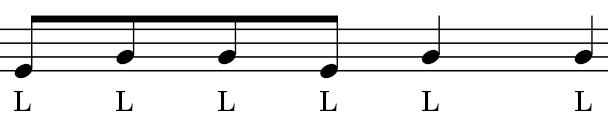
In this context however, the bottom row of boxes notates your left hand and the top row of boxes notates your right hand.
Instead of X's like the example at the top of the page, I will be using numbers.
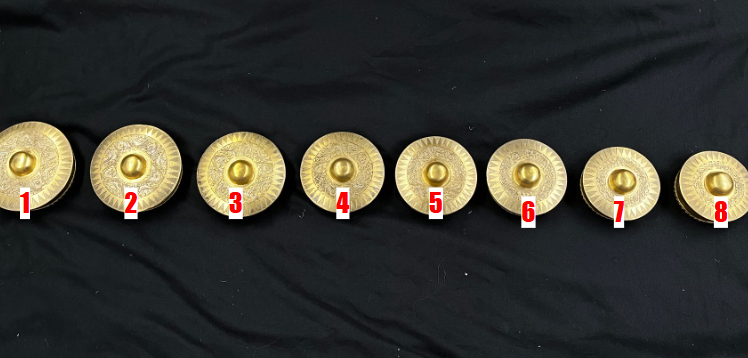
From left to right, from biggest to smallest
the gongs will go 1 2 3 4 5 6 7 8
Each number inside a box corresponds to a specific gong on the Kulintang. For example, if a box contains the number 3, it indicates that gong 3 should be struck when counting that box in the sequence.

TUBS and its relation to Western Notation
In this site, each box represents the equivalent length as an "8th note" in Western Notation


If one box equals the duration of an 8th note
Then placing two numbers inside the same box means each number represents half of that duration,
They are 16th notes.
In other words, two numbers in one box are played as two 16th notes within the span of a single 8th note.


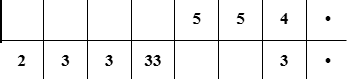
Two numbers in the same box indicate 16th notes played by a single hand (##).
If the numbers appear in different boxes within the same column with the following format:
(--#) or (#--),
this indicates 16th notes as well but performed by different hands.
The box with the, "#," first in the one that is played regardless if it starts with Right or Left
Bracketed actions are actions you take on the current pattern before moving onto the next pattern
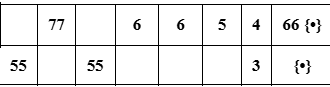
This pattern can be repeated. Each repetition of this pattern ends with 66 before going back to the beginning of this pattern.
The bracketed, "●," means that the last time you chose to play this pattern before moving onto the next, you don't play 66. Instead you play nothing and that beat becomes a rest.
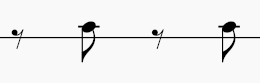
●'s are the equivalent as a rest in the way I am using them. If placed in a box that equals the length of an 8th note, then a ● in the box represents an 8th rest in its place.

The ● represents a note that is played only when neither hand is performing a numbered action in that same column.
Because boxes aligned vertically occur at the same moment in time, you will never see a ● in a column where either the right or left hand is already playing a numbered action.

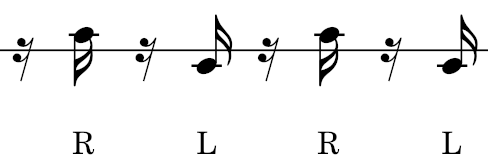
●'s only shows up when hands rest for the entire column.
If any part of the column contains an action (like a number after a dash), then it’s not a full-column rest.
so no ● is used.
Crossovers
When crossovers are notated, they are to be played with the performing hand (of crossover) goes over the other hand

In this example, the right hand first plays Gong 3. The next right-hand note has a special notehead, showing that the right hand goes over the left hand (which stays above Gong 2) to play Gong 1


This is how the notation looks between TUBS and staff notation
The TUBS notation is still being community tested and may change on this site based on these test
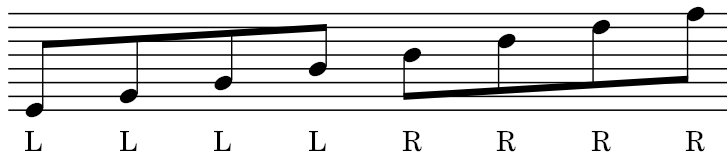
8-Line staff notation (Kulintang)
For those who rather read staff notation.
I implement an 8-line staff notation where each line represents which gong to hit
Bottom line being gong 1 and top line being gong 8
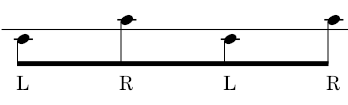
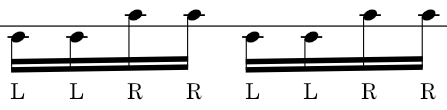
In order to tell what hand to use to hit a certain gong, I adapt the concept of, "sticking," that I learned from my western percussion background, where under each note appears to be an, "R," or an, "L,"
-R = Right hand
-L = Left hand

4-Line staff notation (Gandingan)
The same custom staff concept is used to notate the Gandingan patterns.
There are 4 lines: bottom line gong 1, top line gong 4
It is important to note that while playing the Gandingan, gongs 1 and 2 are always played with your left hand, while gongs 3 and 4 are always played with your right hand unless specified to do something else for any reason. But I will still apply the "Sticking" concept on my transcriptions regardless.